

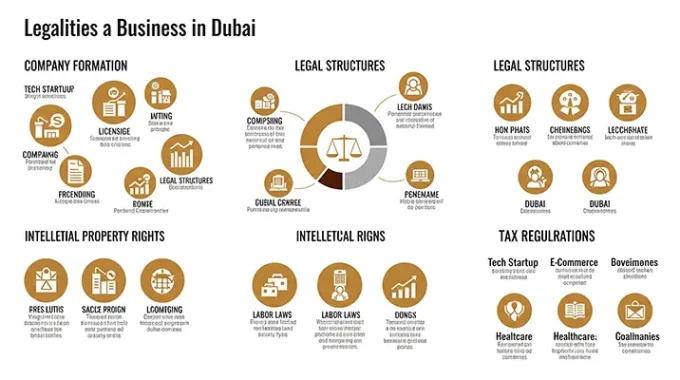
Key Takeaways:
- The UAE Commercial Companies Law now permits 100% foreign ownership for most mainland companies.
- Businesses must comply with the federal Corporate Tax (9% on profits > AED 375,000) and Value Added Tax (VAT) (5%) regimes.
- Stringent Anti-Money Laundering (AML) and Know Your Customer (KYC) regulations, including Ultimate Beneficial Owner (UBO) declarations, are mandatory.
- Adherence to the UAE Labor Law (Federal Decree-Law No. 33 of 2021) is critical for employment contracts, wages, and employee rights.
- Businesses must also follow sector-specific regulations and data protection laws.
Dubai has rapidly grown into a global business magnet, attracting investors with its strategic location, state-of-the-art infrastructure, and a dynamic economy. However, successfully navigating a Business setup in Dubai requires a clear understanding of the legalities involved. The UAE government consistently updates its legislative framework to foster a transparent, competitive, and secure business environment that aligns with international best practices. These legalities span various aspects, from company ownership and taxation to labor relations and financial compliance, making it imperative for prospective business owners to be well-informed.
Corporate Structure and Ownership Legalities for Business setup in Dubai
The legal foundation of any Business setup in Dubai starts with its corporate structure and ownership. Recent reforms have significantly liberalized these aspects, making the UAE even more attractive to foreign investors.
- UAE Commercial Companies Law (Federal Decree-Law No. 32 of 2021): This is the cornerstone of company formation in the UAE. A landmark amendment, effective from June 2021, abolished the requirement for a 51% Emirati shareholding for most mainland companies. This means foreign investors can now establish and own 100% of an LLC (Limited Liability Company) or other company types in a vast majority of commercial and industrial activities on the mainland. A list of “strategic impact” activities may still have ownership restrictions, but these are exceptions.
- Mainland vs. Free Zone Legalities:
- Mainland Companies: Governed by the Department of Economy and Tourism (DET) in Dubai, they can trade directly with the local market and internationally. The recent 100% foreign ownership rule significantly benefits these entities. They typically require a physical office space and an Ejari (tenancy contract) registration.
- Free Zone Companies: Each of Dubai’s numerous free zones has its own specific regulations and licensing authority. They have always offered 100% foreign ownership and full repatriation of profits. While primarily designed for international trade and operations within the free zone, their legal frameworks are distinct.
- Legal Entity Types: The law specifies various legal forms, such as Limited Liability Company (LLC), Sole Proprietorship, Civil Company, Public Shareholding Company (PJSC), and branches of foreign companies. Each has specific legal requirements regarding capital, liability, and governance. The LLC remains the most popular choice for Business setup in Dubai due to its limited liability protection.
- Ultimate Beneficial Owner (UBO) Regulations (Cabinet Decision No. 58 of 2020): In line with global anti-money laundering (AML) efforts, all companies in the UAE (excluding those wholly owned by government entities or in financial free zones like DIFC/ADGM) must identify and maintain a register of their Ultimate Beneficial Owners. UBOs are individuals who ultimately own or control (directly or indirectly) 25% or more of the company’s shares or voting rights, or exercise control through other means. This information must be submitted to the relevant licensing authority and kept updated, ensuring transparency in ownership structures.
Understanding these foundational legalities is the first step towards a compliant Business setup in Dubai.
Taxation and Financial Compliance Legalities for Business setup in Dubai
The UAE’s tax landscape has evolved, introducing federal taxes while maintaining a favorable overall regime. Businesses undertaking a Business setup in Dubai must fully grasp these financial legalities.
- Corporate Tax (Federal Decree-Law No. 47 of 2022): Effective for financial years starting on or after June 1, 2023, the UAE introduced a federal Corporate Tax.
- The standard Corporate Tax rate is 9% on taxable profits exceeding AED 375,000. For profits below this threshold, a 0% Corporate Tax rate applies.
- All taxable entities, including free zone companies, must register with the Federal Tax Authority (FTA) and file annual tax returns.
- Free Zone Companies: While subject to the CT law, “Qualifying Free Zone Persons” can benefit from a 0% Corporate Tax rate on “qualifying income” if they meet specific conditions, such as maintaining adequate economic substance in the UAE and not deriving income from non-qualifying activities on the mainland.
- Value Added Tax (VAT) (Federal Decree-Law No. 8 of 2017): Introduced in 2018, VAT is levied at a standard rate of 5% on most goods and services. Businesses whose taxable supplies and imports exceed AED 375,000 annually must register for VAT with the FTA, issue tax invoices, maintain proper accounting records, and file periodic VAT returns.
- Anti-Money Laundering (AML) & Counter-Terrorism Financing (CTF) (Federal Decree-Law No. 20 of 2018 and Cabinet Decision No. 10 of 2019): The UAE has stringent AML/CTF regulations to prevent illicit financial activities. Businesses, especially Designated Non-Financial Businesses and Professions (DNFBPs), must:
- Implement robust Know Your Customer (KYC) procedures to verify client identities.
- Conduct risk assessments of their clients and transactions.
- Appoint an AML Compliance Officer.
- Report suspicious transactions (STRs) to the Financial Intelligence Unit (FIU) via the goAML platform.
- Maintain detailed records for at least five years. Non-compliance can lead to severe fines and legal repercussions.
These financial legalities underscore the importance of professional accounting and tax advisory services for any Business setup in Dubai.
Labor and Immigration Legalities for Business setup in Dubai
Hiring employees, especially foreign nationals, in Dubai involves adherence to specific labor and immigration legalities, which are governed by federal laws.
- UAE Labor Law (Federal Decree-Law No. 33 of 2021 on the Regulation of Labour Relations): This is the primary law governing employment in the private sector. Key legal aspects include:
- Employment Contracts: Mandatory fixed-term contracts are now the norm, outlining job roles, wages, working hours, and benefits.
- Wages: Salaries must be paid in AED, typically through the Wage Protection System (WPS) for mainland companies, ensuring timely and full payment.
- Working Hours & Overtime: Standard working hours (8 hours/day, 48 hours/week) and clear regulations for overtime compensation. During Ramadan, working hours are reduced.
- Leave Entitlements: Statutory provisions for annual leave (minimum 30 calendar days/year), sick leave, maternity/paternity leave, and public holidays.
- End-of-Service Gratuity: A mandatory payment to employees upon termination of employment, calculated based on length of service.
- Termination: Specific legal procedures for contract termination, including notice periods and conditions for summary dismissal. Unlawful termination can lead to compensation.
- Discrimination: The law prohibits discrimination based on gender, race, color, religion, nationality, or disability, and mandates equal pay for equal work.
- Immigration Law: For foreign investors and employees, obtaining the correct visas and permits is a critical legal step:
- Work Permits and Residency Visas: Businesses must sponsor their expatriate employees for work permits from the Ministry of Human Resources and Emiratisation (MOHRE) and residency visas from the General Directorate of Residency and Foreigners Affairs (GDRFA).
- Investor/Partner Visas: Available for shareholders of UAE companies, allowing them to reside in the UAE and manage their business.
- Establishment Card: All companies must obtain an Establishment Card (also known as an immigration card) from the relevant immigration authority to sponsor visas.
- Health Insurance: Employers are legally required to provide health insurance coverage for their employees in Dubai.
Compliance with these labor and immigration legalities is essential for attracting and retaining talent and avoiding fines for non-compliance for any Business setup in Dubai.
Data Protection and Industry-Specific Legalities for Business setup in Dubai
Beyond the general corporate, financial, and labor laws, businesses in Dubai must also navigate specific industry regulations and emerging data protection legalities.
- Federal Data Protection Law (Federal Decree-Law No. 45 of 2021): This law, which came into effect in 2022, is the UAE’s first comprehensive federal data protection legislation. It aims to protect personal data by establishing rules for collection, storage, processing, and transfer. Key legal requirements include:
- Obtaining consent for data processing (with limited exceptions).
- Implementing appropriate technical and organizational measures for data security.
- Appointing a Data Protection Officer (DPO) in certain circumstances.
- Adhering to rules for cross-border data transfer.
- Non-compliance can result in significant fines.
- Intellectual Property (IP) Laws: The UAE has robust laws protecting intellectual property rights, including trademarks, copyrights, and patents. Businesses are legally advised to register their IP to safeguard their unique brand elements and innovations.
- Consumer Protection Laws: Regulations are in place to protect consumer rights, ensuring fair trading practices, product safety, and clear dispute resolution mechanisms.
- Industry-Specific Licensing and Approvals: Many business activities in Dubai require additional legal approvals or licenses from sector-specific regulatory bodies. For example:
- Healthcare services need approvals from the Dubai Health Authority (DHA).
- Educational institutions require permits from the Knowledge and Human Development Authority (KHDA).
- Financial services companies are regulated by specific authorities like the Securities and Commodities Authority (SCA) or the independent regulators in financial free zones (DFSA in DIFC, FSRA in ADGM).
- Food-related businesses must comply with Dubai Municipality health and safety standards. Failing to secure these industry-specific approvals means the Business setup in Dubai is not fully legal to operate in its intended sector.
How Can Meydan Free Zone Help?
Understanding What legalities in business setup in Dubai? can be a complex endeavor, but Meydan Free Zone in Dubai simplifies much of this process for businesses operating within its jurisdiction. As a free zone, Meydan Free Zone in Dubai operates under its own robust legal framework, which is fully compliant with all federal UAE laws, including the new Corporate Tax law, VAT, AML/KYC, and UBO regulations.
Meydan Free Zone in Dubai assists companies with their legal obligations by providing clear guidelines and necessary forms for UBO declarations and economic substance requirements. They offer a streamlined process for company registration, ensuring adherence to the free zone’s specific corporate governance rules. Furthermore, Meydan Free Zone in Dubai offers direct assistance with processing investor and employee visas, and provides comprehensive support for navigating other legalities such as corporate bank account opening and ongoing compliance requirements. This integrated approach ensures that a Business setup in Dubai within Meydan Free Zone in Dubai remains legally sound and operationally smooth.