

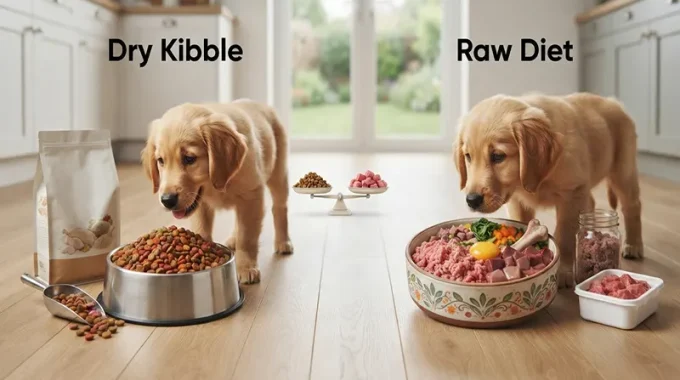
Welcoming a Golden Retriever puppy into your home brings an immediate wave of joy—followed quickly by an overwhelming amount of advice on how to raise them. Among all the decisions you will make, few spark as much intense debate as nutrition. Golden Retriever puppies have unique developmental vulnerabilities, making their early diet choices critical to their long-term health.
As you navigate the pet food aisles or online forums, you will inevitably find yourself caught in the crossfire of the great modern nutrition debate: the safety and scientific consistency of premium dry kibble versus the ancestral, highly palatable appeal of a raw food diet.
The Golden Retriever Growth Equation: Why Puppy Nutrition Matters
Golden Retrievers are classified as large-breed dogs, meaning they experience a rapid, dramatic skeletal expansion during their first 12 to 18 months of life. This unique growth trajectory introduces strict physiological requirements that smaller breeds simply do not face.
- Skeletal Vulnerability: Large-breed puppies are highly susceptible to developmental orthopedic diseases, such as hip and elbow dysplasia, if their growth rate is mismanaged.
- The Mineral Precision Rule: Bone development relies entirely on strict, controlled ratios of calcium to phosphorus. Excess calcium or unmonitored caloric density causes bones to lengthen and thicken too quickly, leading to structural malformations.
Because of these risks, whatever food you choose must support steady, controlled structural growth rather than maximum weight gain.
Contender A: Dry Kibble (Pros, Cons, and Large-Breed Realities)
Dry kibble remains the most common feeding choice for puppies worldwide, backed by decades of scientific formulation.
The Pros:
- Safety and Sterility: High-heat extrusion manufacturing eliminates harmful pathogens like Salmonella and E. coli.
- Nutritional Completeness: Reputable commercial brands that adhere to World Small Animal Veterinary Association (WSAVA) guidelines or AAFCO standards feature rigorously tested formulas with precise nutrient profiles.
- Convenience and Cost: Kibble is shelf-stable, easy to measure, and significantly more affordable over time.
The Cons:
- Processing Impact: High-heat cooking can degrade certain natural nutrients, requiring synthetic vitamin packs to be sprayed back onto the kibble.
- Carbohydrate Load: Most dry kibbles rely heavily on starches and binders (like corn, wheat, peas, or potatoes) to hold the shape of the kibble.
Key Focus for Goldens: Always select a diet specifically labeled “Large-Breed Puppy.” These formulations feature controlled calorie counts and precise calcium limits designed explicitly to protect a Golden Retriever’s developing joints.
Contender B: Raw Diets (Pros, Cons, and Safety Realities)
Raw diets—consisting of uncooked muscle meat, organ meats, and sometimes raw bones or vegetables—mimic an ancestral canine diet and have surged in popularity.
The Pros:
- High Digestibility: Many owners report that raw-fed dogs produce smaller, firmer stools because the body utilizes a higher percentage of the nutrient content.
- Minimal Processing: Because the food is uncooked, natural enzymes and amino acids remain entirely intact without synthetic alterations.
The Cons:
- The High-Risk Calcium Trap: Formulating a raw diet for a growing large-breed puppy is notoriously difficult. Eyeballing bone-to-meat ratios or getting calcium-to-phosphorus calculations wrong can lead to severe nutritional deficiencies, spontaneous bone fractures, and crippling developmental diseases.
- Pathogen Hazards: Raw meat frequently harbors dangerous bacteria (like Salmonella and Listeria), posing infection risks not only to the puppy but to human family members handling the food.
- Financial Cost: Sourcing commercially balanced, high-end raw formulas or custom-balancing meals for a fast-growing Golden Retriever puppy is exceptionally expensive.
Direct Comparison & Hybrid Compromises
| Feature | Large-Breed Puppy Dry Kibble | Unbalanced or DIY Raw Diet |
| Nutritional Safety | High (Strictly regulated/tested) | Low-to-Moderate (High risk of error) |
| Pathogen Risk | Zero (Heat-sterilized) | High (Salmonella, E. coli exposure) |
| Joint & Bone Protection | Built-in calcium/phosphorus caps | Requires expert veterinary formulation |
| Monthly Budget | Moderate | High |
For owners torn between the two worlds, hybrid or safe-fresh feeding is emerging as a popular compromise. This involves using a trusted, WSAVA-compliant large-breed puppy kibble as the nutritional base (ensuring safe bone and joint development) while incorporating safe, fresh whole-food toppers (like blueberries, plain Greek yogurt, or cooked lean proteins) for variety.
Feeding a Golden Retriever puppy is a high-stakes responsibility. While raw diets boast high digestibility, the severe risk of nutritional imbalances—particularly calcium overloads during their critical growth window—makes strict raw feeding a dangerous gamble for a growing large-breed dog.