
There is a pervasive myth in the pet world that birds are inexpensive, low-maintenance pets. Because a small bird can often be purchased for a modest adoption fee, many first-time owners assume their ongoing expenses will be minimal.
However, whether you are captivated by the cheerful chatter of a tiny parakeet or the striking intelligence of a larger parrot, the financial reality of avian ownership extends far beyond the initial purchase price. Understanding the true cost breakdown—from startup gear to decades of specialized veterinary care—is essential before bringing a feathered companion home.
Upfront Costs: Bringing Your Feathered Friend Home
The financial journey begins the moment you decide to adopt. Right away, the gap between a small parakeet (budgie) and a larger parrot species becomes apparent.
1. Adoption or Purchase Fees
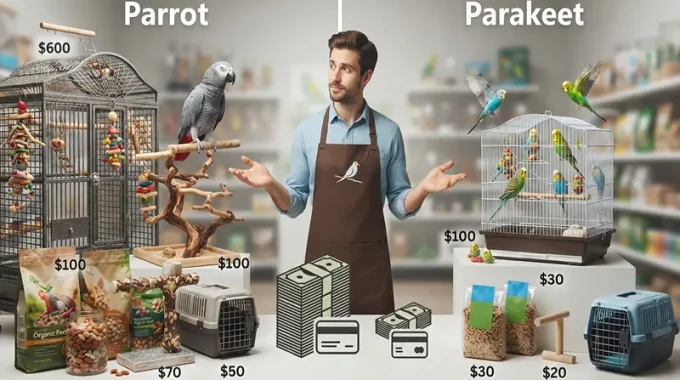
- Parakeet (Budgie): Typically costs between $20 to $50 from a pet store, or even less through a local rescue organization.
- Medium Parrot (Cockatiel, Conure, or Small Hookbill): Generally ranges from $150 to $600+ depending on the specific mutation, breeder, or rescue fee.
2. Essential Startup Gear
While both need a home, the scale of equipment scales rapidly with the size of the bird:
- Cages: A budgie requires a cage with tight bar spacing (1/2 inch or less) costing around $60 to $150. A medium parrot needs a heavy-duty, wider-bar flight cage or playtop enclosure running anywhere from $200 to $600+.
- Accessories: Perches, stainless steel food/water bowls, shreddable toys, calcium blocks, and a secure travel carrier add an immediate $100 to $300 to your initial startup bill.
- Initial Veterinary Exam: Every new bird requires an initial checkup with an avian veterinarian (including baseline fecal tests) costing roughly $100 to $250.
Ongoing Monthly Expenses: Feeding, Foraging, and Upkeep
Once your bird is settled in, monthly consumable costs kick in. This is where physical size dictates your recurring budget.
- Dietary Consumables: A tiny budgie eats very little—consuming high-grade pellets, seeds, and fresh greens at a cost of roughly $10 to $20 per month. In contrast, a medium-to-large parrot requires substantial quantities of specialized pellets, premium seed mixes, fresh daily “chop” (vegetables and grains), and fresh fruit, pushing monthly food bills to $40 to $80+.
- Toys and Destruction Factor: Larger parrots possess powerful beaks designed to pulverize wood. Toys that last a budgie months will be shredded by a conure or cockatiel in hours. Toy replacement budgets range from $10 a month for a parakeet to $30 to $60 a month for a busy parrot.
- Miscellaneous Upkeep: Cage liners, bird-safe disinfectants, and cage accessories add another $10 to $20 monthly.
The Long-Term Financial Horizon: Veterinary Care and Lifespan
The most significant financial differentiator between parakeets and parrots is not just monthly upkeep—it is the sheer timeline of responsibility.
- Avian Veterinary Care: Exotic veterinarians charge higher rates than standard dog and cat vets. An emergency visit, bloodwork, or respiratory treatment can easily range from $300 to $1,000+. Unlike traditional pets, traditional pet insurance for exotic birds is sparse, meaning owners must often self-fund emergency medical savings.
- Lifespan Multipliers:
- Parakeets (Budgies): Generally live 5 to 10 years.
- Medium Parrots (Cockatiels/Conures): Regularly live 15 to 25+ years.
- Large Parrots (Macaws/Amazons/Cockatoos): Can live 40 to 60+ years.
When you multiply a parrot’s lifespan across decades, you are looking at a long-term financial commitment that rivals college savings funds or automotive investments.
Decision Matrix: Which Fits Your Budget?
| Expense Category | Parakeet (Budgie) | Medium Parrot (Conure / Cockatiel) |
| Initial Startup Cost | $150 – $350 | $500 – $1,200+ |
| Monthly Upkeep | $25 – $45 | $80 – $150+ |
| Expected Lifespan | 5 – 10 years | 15 – 30 years |
| Estimated Lifetime Cost | $2,000 – $5,000 | $15,000 – $40,000+ |
Choosing between a parakeet and a parrot is not just a decision about noise levels or space constraints—it is a major financial commitment. While a parakeet offers a delightful, highly economical entry point into bird ownership with lower upfront and monthly costs, larger parrots demand robust, long-term budgeting that accounts for decades of specialized care, toy destruction, and medical needs.