
The allure of owning an exotic cat—whether it is a spotted Bengal, a towering Savannah, or a wild African serval—has skyrocketed over the last decade. However, unlike traditional domestic cats, bringing an exotic or hybrid feline into your home involves navigating a labyrinth of federal, state, and municipal legislation.
Because laws governing wild and hybrid animals vary wildly, understanding the legal landscape is an absolute necessity before committing to ownership.
The Spectrum of Ownership: Hybrids vs. Pure Wild Felines
Legally speaking, not all exotic cats are categorized the same way. States generally draw a sharp line between domestic hybrid crosses and pure wild species.
- Domestic Hybrids (e.g., Savannah and Bengal Cats): These are crosses between a domestic cat and a wild species (such as an Asian Leopard Cat or an African Serval). Laws usually categorize them by “filial generation” (F1, F2, F3, F4, etc.).
- Early Generations (F1–F3): These cats possess a high percentage of wild DNA and are frequently subject to the same strict regulations or bans as pure wild cats.
- Later Generations (F4 and beyond): Usually considered legally domestic in most states, meaning they can be owned without special permits.
- Pure Wild Felines (e.g., Servals, Caracals, Ocelots, Bobcats): These are un-diluted wild animals. Private ownership is heavily restricted, strictly regulated, or completely banned across the majority of the United States. Furthermore, federal legislation like the Big Cat Public Safety Act severely restricts public contact and interstate commerce for major wild cat species.
State-by-State Regulatory Landscape
State laws regarding exotic and wild cats generally fall into three distinct regulatory buckets:
1. Total Bans
In states with comprehensive bans, private ownership of pure wild cats and early-generation hybrids is strictly illegal.
- Examples: States like California, Hawaii, and Alaska have zero-tolerance policies for keeping wild felines or unregulated exotic hybrids as pets. Violating these laws can result in heavy fines and the immediate confiscation (and potential euthanasia) of the animal.
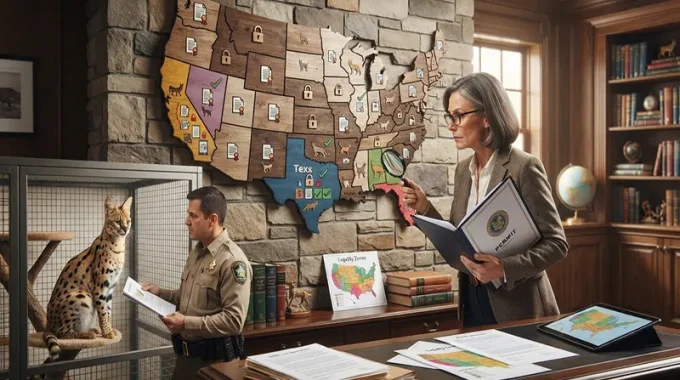
2. Permit and Licensing States
In these jurisdictions, ownership is legal only if the owner passes background checks, pays application fees, proves compliance with strict facility standards, and often carries high-liability insurance.
- Examples: States like Texas, Florida, and Pennsylvania allow certain exotic or wild cats, but owners must acquire explicit state permits, register the animal, and permit regular inspections of their property.
3. Unregulated or Minimal Regulation States
A small handful of states have few to no statewide restrictions regarding the ownership of certain mid-sized exotic cats like servals or bobcats.
- The Municipal Catch: Even if a state has lenient laws, county or city ordinances almost always override state leniency. Many cities ban exotic pets entirely within city limits, meaning an owner living just outside city lines might be legal while their neighbor a mile away is breaking the law.
What Compliance Involves
If you live in a state where owning an exotic cat is legally permissible, compliance rarely stops at just buying the animal. Standard legal requirements often include:
- USDA Licensing: If you breed or exhibit the animal commercially, federal USDA oversight applies. Even for private pets, specific documentation regarding acquisition and veterinary care is routinely audited.
- Specialized Enclosures: Many states mandate specific outdoor containment protocols—such as double-door security airlocks, reinforced concrete-anchored chain-link fencing, and mandatory microchipping.
- Rabies Vaccination Hurdles: This is a major legal grey area. Many states require proof of a rabies vaccination for felines, yet no rabies vaccine is officially approved or licensed by the USDA for wild cats or exotic hybrids. If a non-vaccinated exotic cat bites someone, public health departments often legally mandate euthanasia to test for rabies, regardless of ownership status.
Responsible Ownership Verdict
Navigating the legal framework of exotic cat ownership requires intense, meticulous research. A hybrid or wild cat that is entirely legal to own in a rural county in Nevada or Alabama may be strictly contraband in a neighboring municipality or state.