

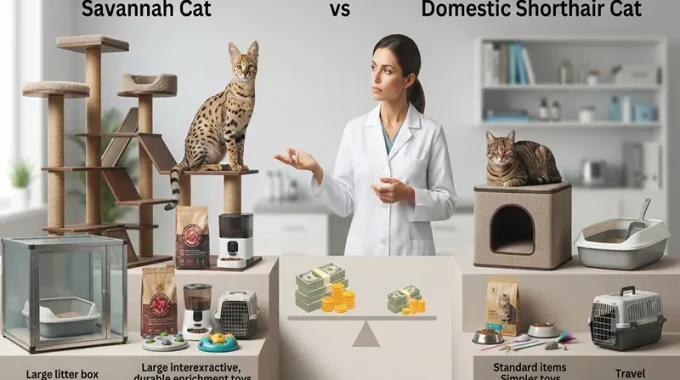
There is an undeniable allure to the wild aesthetic of a Savannah cat. Standing tall with long legs, large cupped ears, and striking spotted coats that mirror their African serval ancestry, these hybrid felines look like miniature leopards walking through your living room.
However, inviting a hybrid animal into your home is an entirely different financial and lifestyle commitment than adopting a traditional domestic cat. While a standard domestic cat is a straightforward, budget-friendly companion, a Savannah cat—particularly early filial generations like F1 to F4—represents a massive, multi-faceted investment. Understanding the true cost breakdown is essential before taking the leap.
Upfront Acquisition and Legal Investment
The financial divergence between a domestic cat and a Savannah cat begins the very second you look to bring one home.
1. Purchase and Adoption Fees
- Traditional Domestic Cat: Typically costs anywhere from $50 to $200 as an adoption fee from a shelter or rescue organization, which usually includes spaying/neutering, microchipping, and initial vaccinations. Purebred domestic kittens from ethical breeders range from $500 to $1,500.
- Savannah Cat: Prices vary drastically based on the generation (filial level). Later generations (F5 and beyond) might range from $1,000 to $3,000, while early generations (F1 through F3) with direct serval lineage frequently command anywhere from $7,000 to $20,000+.
2. Permits, Zoning, and Legal Compliance
- Domestic Cat: Requires no special government paperwork or permits.
- Savannah Cat: Depending on your state, city, or county, owning an exotic hybrid may require special permits, expensive licensing fees, or property zoning compliance. In some regions, early-generation hybrids are strictly regulated or outright banned, potentially adding legal fees and enclosure requirements to your startup budget.
Ongoing Dietary and Nutritional Demands
Feeding a domestic cat is predictable and affordable; feeding a Savannah cat requires specialized nutrition to fuel their high-energy, athletic frames.
- Traditional Domestic Cat: Standard commercial kibble and canned wet food run a modest $30 to $60 per month.
- Savannah Cat: These cats often thrive best on specialized high-protein diets, raw meat formulas, or whole-prey components to meet their unique metabolic needs. Commercial cat food often lacks the specific taurine and protein profiles required for optimal hybrid health. Monthly grocery and supplement bills easily run $150 to $300+ per month.
Home Environment, Destruction, and Enrichment Costs
Savannah cats are exceptionally intelligent, highly athletic, and possess an immense leaping ability (often jumping up to 8 feet from a standing position). Their environmental footprint requires heavy-duty investment.
- Traditional Domestic Cat: Standard scratching posts, a couple of litter boxes, and standard window screens keep a domestic cat perfectly content, keeping household damage minimal.
- Savannah Cat: They require industrial-strength gear. Standard scratching posts will be shredded instantly, demanding heavy-duty wood or sisal climbing structures. Because they are notorious escape artists and problem solvers, standard window screens must often be replaced with reinforced pet-proof mesh. Heavy-duty, extra-large litter enclosures are also a must to handle their larger size and high-velocity digging, bringing cumulative setup and replacement costs to hundreds of dollars annually.
Veterinary Care, Insurance, and Lifespan
Medical costs for an exotic hybrid can catch unprepared owners off guard.
- Traditional Domestic Cat: Standard veterinary care is straightforward, routine, and easily covered by traditional pet insurance providers.
- Savannah Cat: Finding an experienced exotic veterinarian who understands hybrid physiology is mandatory. Furthermore, certain standard vaccinations (such as modified-live virus vaccines) can sometimes trigger adverse or fatal reactions in hybrid cats, requiring specialized care protocols. Pet insurance for early-generation hybrids is either extremely expensive or unavailable, meaning owners must maintain robust emergency savings.
Side-by-Side Cost Comparison
| Expense Category | Traditional Domestic Cat | Savannah Cat (F1–F4) |
| Initial Acquisition | $50 – $1,500 | $1,000 – $20,000+ |
| Permits & Legal Fees | $0 | $50 – $500+ (location dependent) |
| Monthly Food & Supplies | $30 – $60 | $150 – $300+ |
| Gear & Environment Upgrades | $50 – $150 | $500 – $2,000+ (reinforced spaces) |
| Expected Lifespan | 12 – 18 years | 12 – 20 years |
Owning a standard domestic cat is a wonderful, budget-friendly experience that fits seamlessly into almost any household lifestyle. In contrast, caring for a Savannah cat—especially an early-generation hybrid—requires the dedication of an exotic enthusiast, robust financial planning, and a lifestyle built around accommodating a high-energy, highly demanding wild spirit.